Making · SCORCHSTUDIO
Light that cuts.
A slow-motion look at a laser drawing a name, one pass at a time.
WRITER: READ. · onehelpst. · 31 OCT 2026 · 5 MIN READ
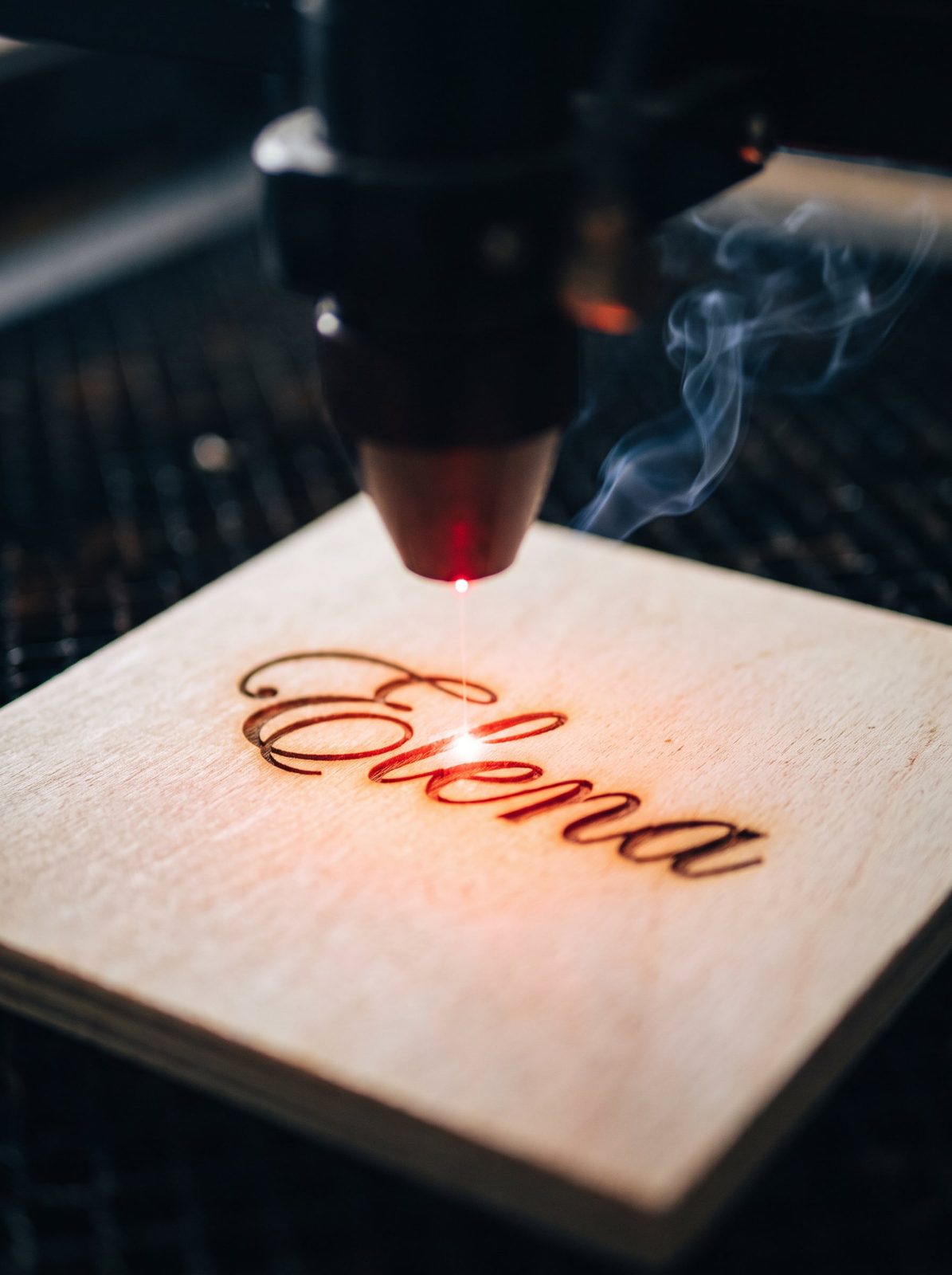
Watch a laser engrave a name and it looks as if nothing is happening. There is no blade and no tool touching the surface, just a bright point moving back and forth, a faint wisp of smoke, and then letters where there were none. Here is what happens in those seconds.
A beam squeezed to a point
A laser beam starts out wider and relatively gentle. Inside the head, a lens focuses it down to a spot a fraction of a millimetre across. Spread out, that energy would barely warm the surface. Concentrated, it is enough to vaporise, melt or burn away a thin layer of material. That is why focus matters so much: the sharp point has to sit at, or just below, the surface, or the mark spreads and chars.
Heat, time and the mark
How long the beam rests on a spot decides what you see. A short exposure can simply change the colour of the surface and create contrast. A longer one removes material and cuts into it. Either way the mark is permanent and hard to rub off, and because nothing touches the piece, there is no tool to wear down and nothing to clamp.
Line by line, or along the line
There are two ways to draw. In raster engraving the design is made of pixels, and the beam sweeps back and forth, line by line, filling in shapes the way a printer lays down a picture. It is used for filled letters, photos and shaded areas. In vector work the beam follows the outline of each line or curve, one after another. That is how thin lines are scored and how shapes are cut right through.
Pass after pass
A name is rarely done in one go. Engraving deeper means more passes or a slower speed, and thicker sheets can take more than one pass to cut. Power and speed are always tested on an offcut first, because there is no number that suits every material.
What takes a mark well
Wood, acrylic and leather are workshop favourites, along with paper, card and felt, and coated metals can be marked too. Some materials should never go near a laser: PVC and vinyl, polycarbonate and fibreglass are on the do-not-cut list in makerspaces for good reason.
And then there’s colour
Engraving takes material away. UV printing adds it. A UV printer jets tiny drops of ink onto the surface, and ultraviolet light cures each pass almost instantly, so the print is dry and hard the moment it is finished. Because the ink doesn’t need to soak in, it prints straight onto plastic, metal, wood, glass, leather and acrylic, and it can build up textured prints you can feel with your fingers.
Made here
At SCORCH·STUDIO everything is laser engraved and UV printed in our studio at onehelpst., three trades under one roof on Help Street. The easiest way to try it is a tile: A$29 for one from our wall, A$35 for your own design, A$45 for your photo, and ceramic is A$15 more. Start at tile.onehelpst.com.
Sources